Thursday, May 24, 2012

TOK and CAS

To what extent can symbols be used to unite people?

One of my favorite CAS activities is Field Hockey. This relates back to the Nelson Mandela quote:

"Sport has the power to change the world. It has the power to inspire, it has the power to unite people in a way that little else does. It speaks to youth in a language they understand. Sport can create hope, where once there was only despair. It is more powerful than governments in breaking down racial barriers. It laughs in the face of all types of discrimination."


I started Field Hockey later than when most people start to play sports. I started in my sophomore year of High School. Though I have only been playing for two years, field hockey is one of my favorite things to do. I have made all sorts of new friends, with people I never thought I would be friends with. I believe that field hockey has brought us all together. We are untied for a common good, and it allows us, as a whole to work together. Although we don't often win, in fact we almost never do, we all love each other and stand by each other. 


Sunday, April 29, 2012

Decision Making: Emotion vs. Reason

  1. High Reason are choices that are made based off of logical conclusions. The somatic hypothesis is that we are often faced with decisions that involve lots of different alternatives. We usually try to choose the one that we think will be most beneficial to our well being.
  2. Teenagers do not have as much myelin, as adults. The lack of the fatty white substance surrounding the brain, myelin, causes reactions and decisions to be made slower and are more difficult to make.
  3. The cerebellum is not only involved in physical process but in mental decisions as well. Just as we can physically clumsy, we can be mentally clumsy too. 
  4. The socialization of babies will affect their morals. Babies can be influenced based on who they are socialized with. By socializing babies in the same way, we can create a set of universal morals.
  5. When making a decision and taking an action, there a few different ways to know if the benefits outweigh the costs. One is to think for a long time, not just making a rash decision. Another is to make a pros and cons list. I think that it does matter. Oftentimes, I will make decisions and then later regret that I acted on it. 

Friday, April 13, 2012

WOK emotion – contemporary links

This article is taken from the Cape Cod Times and is entitled Teen ordered held in Falmouth shooting.

This article is about the shooting that happened in East Falmouth on Thursday, April 12, 2012. 18 year-old, Devante Fernandes, shot his stepfather. There was a three hour manhunt following the shooting and nearby Teaticket Elementary School was put into lockdown.

Where Devante Fernandes' emotions that caused him to shoot his stepfather a result of the society he lived in?

Friday, April 6, 2012

IB Survey

1.Which word best describes the IB programme at Sturgis?

Challenging, Rigorous, Worth-while

2. What are the most important qualities for an IB student?

An IB student has to be a risk-taker, and has to persevere.

3. What are the best and worst aspects of being an IB student?

4. The IB is challenging, but in the end it is worth it. There is a lot of work and stress involved, and there are a lot of reflections, which I do not enjoy.

5. Which trait in the IB learner profile do you consider to be most important in your life?

I think that Risk Taker is the most important aspect of the IB learner profile.

6. What is the biggest difference between the IB and the national [state] curriculum in [the USA, or in Massachusetts]?

The IB is much more difficult and prepares you better for college.

7. What type of career would you like to pursue upon leaving school?

I would like to be the captain of a ship or an officer in the Coast Guard.

8. Add one more question of your own to the IB World Student Survey (may be the one chosen in small group discussion), and give your personal response.

(To be asked to people who have gone through the IB)
Do you think that the IB was worth it?

Friday, March 23, 2012

Happiness

If you want others to be happy, practice compassion. If you want to be happy, practice compassion.
Dalai Lama

The purpose of our lives is to be happy.
Dalai Lama


I know that I feel happy when I am smiling or laughing. I know that I am happy when I start Irish Step dancing in place. I know that I am happy when I feel ready to take on the world, and I don't care who is watching.

One way that happiness can limit knowledge is in the sciences. The goal of many people's life is to be happy. Often, when one comes up with a hypothesis in a science experiment, they want it to be correct so that they experience the happiness that goes along with it. This can influence their results because they want to be happy and right.

Friday, March 9, 2012

Machiguenga - Saving a lost language


Machiguenga is a traditional language of Peru. It is spoken by approximately 10,000 people, near Cuzco. The Machiguenga people live in Peru, and have done so since the days of the Inca. They live on the river Urubamba, and make much of their living from the surrounding mountains.
Information Sources (sorry they are in Spanish): Cuidad Archeo Logico, Inka Natura Tavel

Why save Machiguenga?
In Peru, there are many different groups of indigenous people. However, the majority of Peruvians are Mezicos, or a mixture of Spanish and Indigenous people. In this way, many traditions of the native people of Peru are lost, and one important way to preserve this is through language.
Information Source: EF Tour February 2012 Peru, Tour Guides, Washington and Omar.

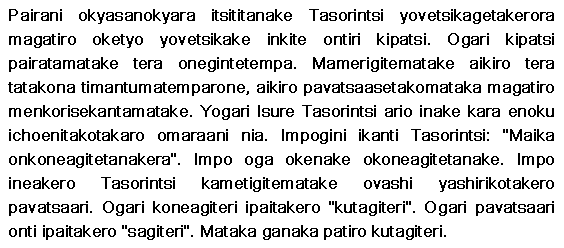
Image

This image shows a Machiguenga translation of the first chapter of Genesis in the Bible.
The Machiguenga language was first written down about 40 years ago, and some of the Machiguenga people are now graduating from tertiary education.
Information: A case study of the Manchiguenga of the Peruvian Amazon , Manchiguenga bible passage

Monday, March 5, 2012

Symbols


1. This symbol is called khamsa, and it is Arabic in origin.
2. This symbol is used to represent the number 5. It is also known as the hand of Fatima, or the King's favorite daughter. It stands for good fortune. It also means, support group, blood revenge group, or closest male relative of five degrees of separation.
3. This symbol is emotive. It is representative of good luck and familial bonds, both of which are positive.
4. The Hand of Fatima takes its name from a female. However, the meaning of the symbol brings the idea of male relatives. Also, the symbol has connotations of bringing good fortune. This makes it seem as though a male is needed to bring good fortune. When did the connotations change from female to male?

Friday, March 2, 2012

WOK language - global views

Culture and Language

Several different language studies are discussed in this article. One was about the difference in language of low income families and high income families. Several studies done in the late 1970s showed a large difference in the use of language in children of low income families and high income families. The studies showed that children of high income families were better able to talk about past and future events, problem solve, reach solutions, and better understood other's feelings and experiences. Another hypothesis is that children who are exposed to academic language at home will do better in school than those who are not. Also, children's socialization may vary with the expectation of competition versus collaboration.

One knowledge claim that is made is that children from low income families speak a different English dialect than children from high income families.

Wednesday, February 15, 2012

Language as a Way of Knowing: Perspectives on the brain, thought and culture

What is the role of language in creating and reinforcing social distinctions, such as class, ethnicity and gender?

Language plays a large part of who are. In my IB Spanish class, I have learned about the difference between the two different yous, tú, and usted. Tú is used among friends, while Usted is used for teachers, strangers, and people older than you are. This is a form of respect between people.
Similarly, the Korean language is full of respect, and your matter of speaking changes depending on whom you are speaking with. People are never called by just their given name, they are either called by both their family and given names or another title. To a girl, an older female is called Unni. Different names for both boys and girls separate the genders, and create a distinction between the two. This is very different from the American society , where we see many unisex names like guys and dude. This level of respect goes farther than just the language. The respect that they use in their language runs in their society, showing up in the way that they act. A waeguken, or foreigner will never feel like they will be a part of Korean society, becuase they will always be a waeguken, and they will therefore never be a Korean.
In my life, I see examples of class and ethnic separation very often. When someone says Yo, they are often associating themselves with lower class African Americans. My use of language, and my pet peeve of when to use adjectives and when to use verbs often makes me seem like a very educated, upper class white girl. However, often times, these assumptions can dig people into a hole, and cause them to make wrong judgments.


Word count: 277

Tuesday, February 7, 2012

Reason as a Way of Knowing - evaluating opposing views

The Omnichild's Dilemma

"And we won’t even have a spouse around to help us, since most of us will be divorced. (You may have heard: We’re hard to live with because we never learned to share.)"

This is my point of view:
This claim is illogical. There is no way that we can tell the future. Also, I am sure that there are plenty of only children who have had long, happy marriages. Also, as an only child, I have learned to share. I can share just fine when I want to, but I believe that every one has a hard time sharing at one point or another, and it is something that we all have to deal with.

Words: 120

Friday, January 27, 2012

Being Logical: A Guide to Good Thinking

Skepticism:

There are two levels skepticism: extreme and moderate. Extreme skepticism means that there is no truth, while moderate skepticism means that some truth is accepted

Evasive Agnosticism

AN agnostic is someone who lacks enough information on something to make a judgement about it. AN agnostic neither denies nor accepts the truth. A person who is agnostic uses ignorance as an excuse.

Narrow Mindedness:

Narrow Mindedness is when a person limits their knowledge. They might be able to find out more, but they don't want to.

Example:

Narrow Mindedness:

IF there was an election, and a person simply voted for someone because they were either a democrat or a republican, this would be narrow mindedness. However, if someone voted for a candidate because they agreed on issues, it would not be narrow
minded.

Wednesday, January 11, 2012

Knowledge Issues

1) How can humans communicate effectively if we are missing senses? How true can our interpretations of those communications be?

2) How can synesthesia affect what we know?

Sunday, January 8, 2012

Logical Fallacies

False Dilemma

A False Dilemma is when someone makes two statements and then one of them is discovered to be false, so the other statement must be true, even though it might be false.

An example of a false dilemma:

Either I buy a car, or I am going to have to get a ride from someone else.

False Dilemma Example

Appeal to Tradition

An Appeal to Tradition Fallacy is when something is declared to be better simply because it older.

Molly: I love my new iPod!
Emilie: I only listen to records, they are way better.

False Dilemma example

Appeal to Novelty

An Appeal to Novelty Fallacy is a fallacy that occurs because someone thinks that something is better simply because it is newer.

Appeal to Novelty Example

Friday, November 18, 2011

Man is the Measure

7. What does Abel mean when he says "to perceive is to solve a problem"?

Abel is saying that when we perceive things, we have to figure out what it means. Figuring out what it means is kind of like solving a jigsaw puzzle.

8. What is the role of social conditioning in determining how things "naturally look?"

The culture that one lives in helps determine how things naturally look. One example of this is Japanese art. Japanese are is often flat, but is still seen as realistic. However, somethings, like Egyptian art aren't perceived as realistic because of the way that the eyes are positioned.

9. What is the significance of the Durer rhinoceros story? How was the influence of convention demonstrated when some tribes were given the photograph?

The Durer rhinoceros story tells us that people's perceptions have a strong basis on what they have been told or seen prior, even if their original perceptions have been changed. The tribes were confused by what was going on, because they had no idea what it was.

11. What does Abel mean when he writes: believing is seeing? How might this point been seen in the study of natural and social sciences.

Abel is saying that when people see things, they believe them. This could be used in the studies of natural and social sciences by showing people things that are not real ans seeing if they believe them.


Sunday, November 13, 2011

Truth and Deception


One way that deception is necessary to knowing is in art. This is escpecially seen in Salvador Dali's Persistence of Memory. Dali did not paint this painting from real life, but instead, he painted it from his mind. Dali painted something that was not real but from his memory probably because he felt that real-life could not express his feelings, but his imagination could. By painting something that looks as if it could be real, but having it not be real, Dali used deception, but his deception was used to convey knowledge. By painting clocks that are easily bent and molded, Dali seems to be trying to say that time can be easily bent. Dali seems to be saying that time can be deceiving. While deception is not always a good thing, Salvador Dali shows us that in art, deception can be used to increase knowledge.

Sunday, October 23, 2011

Hidden Assumptions

  1. I was surprised by my results for the first test I took. I was a little upset, but I felt that I was confused enough by the directions that I felt that that had an effect on my score. for my second test, I was surprised with my results, but I agreed with them.
  2. I don't think that my test results say too much that I should pay attention to. While I think that there might be a littler truth in them, I think that as I said before, I was confused by the instructions enough that it affected my test score
  3. I think that these test are valid, but they have a few exceptions. Some people that that take this test may not have used a computer before, and have no idea as to what is going on. There is also some right/left favoritism. Also, I found the directions slightly confusing.
  4. To be honest, I had to think for a while before I could come up with an answer to this question. One big example of "good" versus "bad" in dominant group in the United States, is how successful a person can be. Sometimes it seems as though white people are expected to better in life than black people. I would say that this could be considered a stereotype. Generalizations tend to be what one person thinks, while stereotypes are what a whole group of people think.
  5. To combat jumping to false conclusions, I think that we need to be taught otherwise form childhood. People learn the best when they are young, and they would understand that no one person is better or worse then them.

Friday, September 23, 2011

Why ToK

Why do we study ToK? It is so that we can get to know ourselves, other, and the ideas surrounding us. * We study Tok to connect ourselves with the rest of the world. We live in one small part of the world, and what we know is minute. We study tok so that we can attempt to understand what is going on in the world.

Tuesday, September 20, 2011

Reading Reflection: "What Every Baby Knows"

1. An "inferential learning mechanism" is the ability to change and rework initial ideas based on experience form the beginning of life. This is really an amazing thing to consider, however much sense it makes. It is basically saying that babies change their thoughts and theories about the world based on their experiences.

2. Within a few days of a baby's birth, they can recognize the faces, voices and smells of those that are close to them. Within the first 9 months, babies can tell the difference in emotion in someone's voice. Within 3 years, babies can recognize that people have different beliefs. These too, are amazing when thinking about the psychology of children. These developments are essential to becoming an adult, and it is amazing that they stat to develop so early.

3. The article states that "Babies are like little scientists continually overthrowing theories that no longer fit the evidence." This statement make complete sense with what the article was saying. According to the article, babies have an idea about what the world will be like as soon as they are born. However, as they grow and begin to have experiences, they add to those theories, and are constantly adapting them based on what they have seen and experienced.